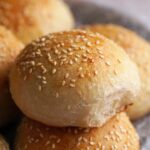
Sourdough Sandwich Rolls Recipe
Perfect for stuffing with your favorite sandwich fillings, these sourdough rolls are fluffy inside with a soft, chewy crust.
Servings 10 servings
Calories 260kcal
Ingredients
To Feed Your Starter:
- 60 grams 100% hydration ripe sourdough starter
- 60 grams unbleached all-purpose flour organic if possible
- 60 grams non-chlorinated water at room temperature (I use bottled water)
Dough:
- 125 grams 100% hydration sourdough starter fed and bubbly (at room temperature)
- 310 grams non-chlorinated water at room temperature (I use bottled water)
- 14 grams fine sea salt
- 12 grams granulated white sugar about 1 tablespoon
- 42 grams unsalted butter melted and cooled slightly (about 3 tablespoons)
- 500 grams unbleached bread flour organic if possible
Other:
- 1 large egg white whisked with 1 tablespoon water (for egg white wash)
- 1 tablespoon sesame seeds or poppy seeds (optional)
Instructions
Feed Your Starter (4 to 12 hours wait time)
- Feed your starter so that it’s at peak when you’re planning to make the dough. Around 4 to 12 hours before you want to make the dough is the general timeframe, but you know how long it takes your starter to reach peak after a feeding, so go with that.
Make the Dough (30 minutes wait time)
- Add the active starter, water, salt, sugar, and melted butter to a large container (TIP: use a glass or clear container so you can see through the sides and bottom), and whisk to combine. Add the bread flour, and stir to form a shaggy dough (don’t knead it).Cover the container and let it sit at room temperature for 30 minutes.
Stretch and Folds (90 minutes wait time)
- Wet your hands and perform your first set of stretch and folds. To do so, grab a piece of dough, gently stretch it up, fold it over, and then rotate the bowl 1/4 turn. Repeat this process 3 more times until you come to the point where you started. Cover the bowl and let the dough rest at room temperature for 30 minutes.After 30 minutes, repeat the stretch and fold process. Cover the bowl and let the dough rest at room temperature for another 30 minutes. Repeat this process 2 more times, for a total of 4 sets of stretch and folds spaced 30 minutes apart.
Bulk Fermentation (6 to 12 hours wait time)
- Let the dough rest (covered) until bulk fermentation is over, about 6 to 12 hours at room temperature. Bulk fermentation is over when the dough looks puffed. (TIP: It doesn’t have to be fully doubled in size; it may be 75%. The top of the dough should be slightly domed and bubbly, and the bottom should look spongy.)
Shape
- Lightly grease a half-sheet pan (18 by 13-inches; or other large baking tray that's a similar size) with a little bit of olive oil, avocado oil, duck fat, beef tallow, or ghee.Either lightly spritz your countertop with a little water and wet your hands, or lightly sprinkle a little flour on your countertop and dust your hands with flour (personally, I find that shaping is a bit easier to do with water). Scrape your dough out onto the prepared countertop and divide it into 10 equal portions (you can weigh each portion if you want the rolls all the exact same size). Use your hands to gently shape each portion of dough into a ball, and then create surface tension by placing the dough ball on the countertop and gently pulling it towards you, repeating a couple times.Place each dough ball (seam-side-down) onto the prepared baking tray spaced evenly apart. Cover the tray with plastic wrap. (TIP: Grease the side of the plastic wrap that will touch the rolls with butter so it doesn't stick to the rolls.)
Proof (1 to 4 hours at room temperature or 12 to 24 hours in the fridge wait time)
- Let the dough rest until it’s properly proofed, about 12 to 24 hours in the fridge or 1 to 4 hours at room temperature. (TIP: You’ll know it’s properly proofed when it looks puffed (it’ll be roughly doubled in size), and jiggles when you gently shake the bowl. Also, the poke test is helpful as a guideline; lightly flour your finger and the dough’s surface, and gently press your finger into the dough. If it springs back slowly (instead of springing back quickly or not at all), it’s ready to bake.)
Preheat the Oven and Bake (1 hour wait time)
- An hour before you want to bake, preheat the oven to 425F; once your oven reaches temperature, set a timer for 1 hour.After preheating the oven for 1 hour, remove the rolls from the fridge, lightly brush the top of each with egg white wash, and sprinkle on the sesame seeds (if using).Bake for 25 to 30 minutes. (TIP: The rolls are done when they're light golden outside, sound hollow when tapped on the bottom, and reach an internal temperature of 200-205F.)
Cool and Slice (about 1 hour wait time)
- Transfer the rolls to a wire rack to cool for about 1 hour (TIP: this prevents a gummy texture).
Notes
- Size: Size-wise, these sourdough rolls are a little smaller than deli-style hard rolls (or Kaiser rolls or Vienna rolls). I did this intentionally because sourdough rolls are heartier and more filling. You can adjust the size to make smaller or larger rolls, just be sure to adjust the bake time accordingly. (TIP: If you make this into 16 rolls, they're about the size of slider buns.)
- Storage: Once they're cool, store these rolls at room temperature in a bread bag or wrapped in a kitchen towel for up to 3 days.
- Freezing: To freeze, let the rolls fully cool first. After that, pop them into a freezer-safe bag and freeze for up to 3 months.
- Reheating: After freezing, for the best flavor and texture, I recommend warming the rolls right before eating. You can warm frozen sourdough rolls in a 400F oven for about 20 minutes (no need to thaw them first!), flipping once halfway through.
Nutrition
Serving: 1roll | Calories: 260kcal | Carbohydrates: 46g | Protein: 8g | Fat: 5g | Saturated Fat: 2g | Polyunsaturated Fat: 1g | Monounsaturated Fat: 1g | Trans Fat: 0.1g | Cholesterol: 9mg | Sodium: 551mg | Potassium: 66mg | Fiber: 2g | Sugar: 1g | Vitamin A: 106IU | Calcium: 19mg | Iron: 1mg