

This post may contain affiliate links, view our disclosure.
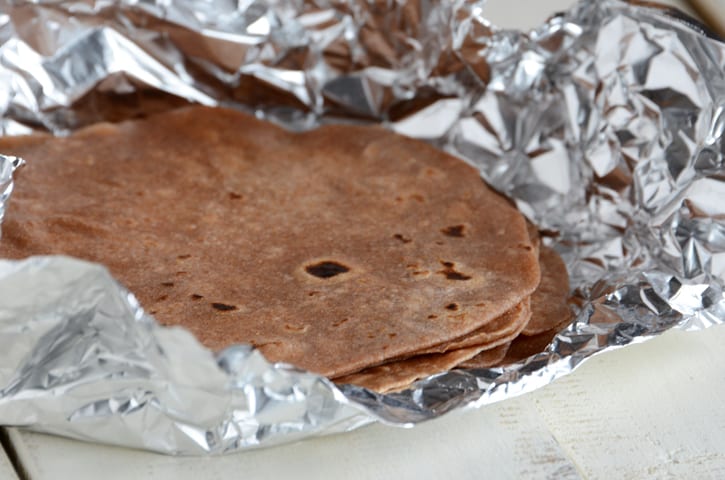 When I was trying to think of what to make for dinner for Mike and I the night before we left for a recent vacation, I noticed a jar of spicy cashew and cream sauce in the pantry that sounded pretty tasty (which it was, especially with chicken and a few veggies added in). To go along with it, I gave Mike a choice between rice and homemade bread. He’s so sweet, at first he said whatever is easier…
Then he got a pensive, far-off look and asked if I minded making bread. I laughed, thinking that I’d much rather be making bread than cleaning/packing/doing laundry like I should be doing to get ready…so bread it was!
When it comes to Indian breads, Mike prefers chapatis but I prefer parathas (excluding naan of course…that’s both of our favorite, but I didn’t have time for that!). Chapatis are unleaved and taste like fresh flour tortillas. Parathas are like chapatis, but due to the addition of butter and a little bit of folding (kind-of like making croissants), parathas are flaky and buttery; of course, parathas are also a bit more work to make. In the end I chose to use chapati dough but add a bit of ghee (clarified butter) as a wink and a nod to parathas.
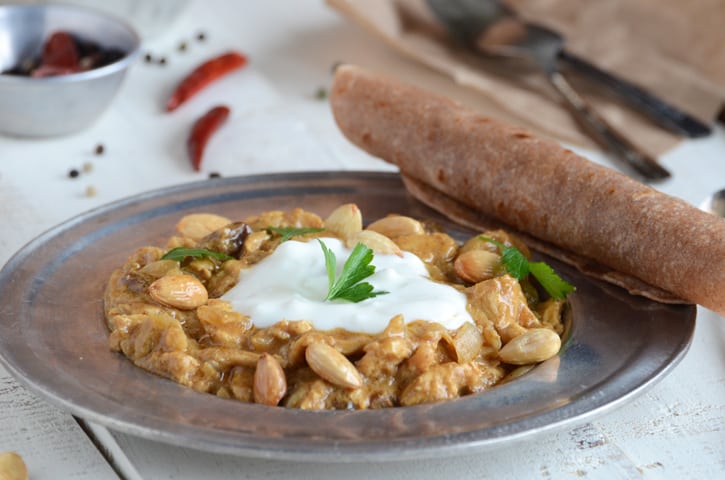 Chapatis (Adapted from the Best Ever Indian Cookbook’s recipe for Chapatis; published by Hermes House)
Makes 8 chapatis
2 cups whole wheat flour
3/4 teaspoon salt
3/4 cup water
2 tablespoons melted ghee (clarified butter), plus more to brush on top once they’re cooked (optional)
Whisk the flour and salt together in a large bowl. Mix with your fingers as you gradually drizzle in the water; once all the water is added, mix in 2 tablespoons melted ghee (if using). Knead the dough until it’s supple and when poked with a finger the indentation remains, about 5 minutes. Wrap the dough in plastic wrap and let it rest 20 minutes at room temperature.
Divide the dough into 8 equal pieces. Use a rolling pin to roll out the pieces 1 at a time. I like to roll out a piece to a circle about 6 inches in diameter, then I gently lift up the dough (you can use a thin metal spatula if necessary) and very gently stretch it while rotating it, as if I were stretching pizza dough. Then I put it back onto the countertop and roll it out again, this time to a circle about 8 inches in diameter, and after that it’s ready to cook. (If you added the ghee to the dough, you shouldn’t need any flour to roll it out; otherwise, use a bit of flour.)
To cook the chapatis, heat a large cast iron skillet or griddle over high heat; once it’s very hot, turn the heat down to medium-high and add a chapati. Turn the chapati over when it starts to bubble; cook until lightly browned in spots on the second side, then turn it back over onto the first side and cook a few seconds until the bubbles puff up. (This entire process for cooking 1 chapati should take about 2 minutes or less; if it’s taking longer, your pan probably isn’t hot enough.) Repeat this process with the remaining 7 chapatis.
As the chapatis are cooked, transfer them to a wire rack and lightly brush them with melted ghee (if using). Cool completely before stacking the chapatis.
To Reheat: Wrap the chapatis securely in foil and place in a 350F oven until warm, about 10 minutes.


I’m the writer, recipe developer, photographer, and food stylist behind this blog. I love finding the human connection through something we all do every day: eat! Food is a common ground that we can all relate to, and our tables tell a story. It’s my goal to inspire you to get in the kitchen, try something new, and find a favorite you didn’t know you had.
Free Bonus

















Your chapatis, a perfect accompaniment to any meal :)
About Indian breads…Naan has certainly been our favourite. However, if rushed to soon run towards vacation…these Chapatis would certainly be the choice bread of the day ;o)
BTW…my Hubby always tells me to do what’s quicker and easier (also very sweet…however, he appreciates when I push for something greater ;o)
Ciao for now and have a great week,
Claudia
Faith, your chapatis look great, like the whole wheat version…
Hope you are having a fabulous week :)
Those chapatis look wonderful. I think they would be good with just about anything!
Adore chapatis! These look perfect!
These look like a delicious meal accompaniment – I love their simplicity too!
This looks absolutely delicious
Thanks for teaching us how to make those picture perfect chapatis!
Mmmm….love your chapatis. They look perfect to me. But like you, I prefer parathas too. I love the flavour and the layered texture. But agree with you, it’s more work. They are just so good with curry, my favourite way of eating them….mmm. Hope you have a great week. Take care. Mary.
I love all Indian breads pretty equally, and like you I’d rather make bread than pack. In fact…I’d rather do almost anything than pack. :P
These look so good and I love how easy they are!
I’ve never tried those!
I’ve never tried making chapatis – yours look just like the ones I’ve seen in the store, nice and thin.
these look just like those at restaurants, great job!!!
Love chapatis, but haven’t had them in quite a while. Thanks for the reminder.
One of my favorite things to do is heat a tortilla in the microwave and smear it with butter for a snack. Doing it with homemade chapatis would be even better! What a sweet wife you are, I wouldn’t have even offered the bread-lol!
I must say that curry does look particularly delicious. The chapatis are really quite simple aren’t they.
I rarely have the patience for even quick flat breads like this on a week night, so they’re often the highlight of ordering takeout. It’s silly when they really are so simple though… And like you, I’d much rather make these than tend to the other chores! ;)
What a treat!! Something I’ve never tasted but has always piqued my interest. Gorgeous image as well!
I have yet to try making Indian bread of any kind so in the meantime, I’ll enjoy looking at yours. :)
This does look easy but very good! I hadn’t heard of it before. I’m always learning about new things from you!
Faith this looks surprisingly easy! I am bookmarking for the next time I make Indian food. Thanks :)
Yummy! I’m seriously a carb fiend and I love any kind of flat bread(although naan does win out usually :D) I love that these are 100% whole wheat – definitely trying them some time soon!
I’ve never had either (but I have had naan…..mmmm!).
Thanks for the education–I’m now prepared when I (1) decide to make indian food or (2) go out to an indian restaurant!
I can’t believe this recipe only takes THREE ingredients … all in my pantry!
I typically run away from making anything bread-y, but *this* I will have to try out.
Thank you for sharing!
That’s so sweet for you to ask Mike :) I usually just make whatever’s easiest for me hehe and what I feel like so poor Mr Bao ends up eating sweet muffins and cupcakes when he wants something savoury hehe
These chapatis look lovely ~ I didn’t know parathas were more buttery because I usually just have naan :D
Never heard of this! But I’m totally intrigued. Simple bread type recipes are always so good!
My father in law tried to make these recently and they turned out horrible! He used a different recipe though and his were a bit burned….haha. I need to show him this recipe to redeem himself!
They look perfect,even I prefer chapatis with curry
What a perfect accompaniment to a curry or a saucy dish! And I like how you used some ghee as a nod to parathas Faith! ;)
These look so simple and worth the time. I bet they went perfectly with your meal.
Lovely chapatis! That is a scrumptious speciality.
Cheers,
Rosa